
A Practical Framework for Enterprise Security, Compliance, and Product Teams
Author: Ololade Ojewale, Business Development Manager at Waibloz
Target Audience: Chief Information Security Officers (CISOs), Data Protection Officers (DPOs), Security Architects, and Product Managers
Publication Purpose: Thought Leadership & Industry Pilot Briefing
Executive Summary
As artificial intelligence adoption accelerates across enterprise environments, employees increasingly rely on browser-based AI assistants to improve their daily operational text. While these workflows deliver measurable productivity gains, they introduce an unmonitored attack vector: sensitive data exfiltration.
Every day, personally identifiable information (PII), proprietary customer details, Application Programming Interface (API) keys, and internal credentials are inadvertently copied into external AI prompts. Standard corporate security policies telling staff, do not paste sensitive data consistently fail against user habits and modern deadline pressures.
This white paper examines the gap between European regulatory mandates, specifically General Data Protection Regulation (GDPR) Article 25/32, the European Union Artificial Intelligence Act (EU AI Act), and Network and Information Security Directive 2 (NIS2) Article 21 and daily enterprise operational realities. We present a practical 6-Step Inline Pre-AI Data Protection Framework designed to detect, classify, and mitigate data exposure risks directly within the browser interface before information reaches third-party AI systems. Finally, we demonstrate how Waibloz LearnFlow operationalizes this framework to significantly reduce leakage risks while retaining full AI utility.
The Invisible Enterprise Risk: Pre-AI Data Ingestion
The corporate adoption of generative AI has outpaced traditional perimeter security. Employees routinely process sensitive documents by copying text into web-based AI tools. This behavior creates several key risks:
- Accidental Exposure of Credentials: Engineers and operations staff frequently paste log excerpts, code blocks, or configuration files containing active database passwords.
- PII Dissemination: HR, customer support, and healthcare teams analyze documents containing individual names, personal identification numbers, email addresses, and phone details.
- Loss of Intellectual Property: Confidential business strategies, unannounced product specs and proprietary research are transmitted to vendor servers without audit logs.
- Third-Party Processing Ambiguity: Once data crosses the perimeter into external AI models, organizations lose control over retention, potential model retraining and subprocessors.
Relying solely on post-hoc log analysis or rigid domain blocking creates friction that drives users toward unmonitored shadow IT. Security governance must shift from reactive prohibition to proactive inline interception.
Regulatory Alignment and Compliance Drivers
European regulatory frameworks strictly penalize inadequate technical measures surrounding data processing. The table below outlines how current regulatory directives impact enterprise AI data ingestion:
| Regulation & Provision | Regulatory Requirement | Operational Real-World Impact on AI Workflows |
|---|---|---|
| GDPR Article 25 (Data Protection by Design & Default) | Technical and organizational measures must be integrated into data processing activities from inception. | Proactive masking and data minimization controls must sit directly in the workflow tool before processing occurs. |
| GDPR Article 32 (Security of Processing) | Implement appropriate technical security, including pseudonymization and encryption based on risk. | Organizations must actively restrict unencrypted or unmasked personal data from being transmitted to third-party AI tools. |
| EU AI Act (Risk Management & Data Governance) | High-risk AI systems and workflows require continuous risk management, data quality governance, and transparency. | Input processing must be logged and monitored for policy violations, sensitive data handling, and compliance alignment. |
| NIS2 Directive Article 21 (Cybersecurity Risk Management) | Essential and important entities must secure supply chains, enforce cryptography/masking, and manage risk. | Enterprise software integrations require robust data protection assurances and verifiable compliance logs with security dashboards. |
The Operational Gap: Policy vs. User Reality
A significant gap exists between regulatory intent and daily employee workflows:
- The Policy Fallacy: Written compliance guidelines are invisible at the point of action. When an employee is under pressure to summarize a 30-page document, vigilance drops.
- Context Switching Friction: Forcing users to manually redact documents in a separate editor before using AI disrupts productivity and leads to policy bypasses.
- The Governance Blind Spot: Chief Information Security Officers (CISOs) and Data Protection Officers (DPOs) lack real-time visibility into what categories of data are currently being passed to external AI services by browser clients.
To bridge this gap, organizations require an automated client-side protection mechanism that evaluates content at the exact moment of user interaction.
The Pre-AI Data Governance Framework
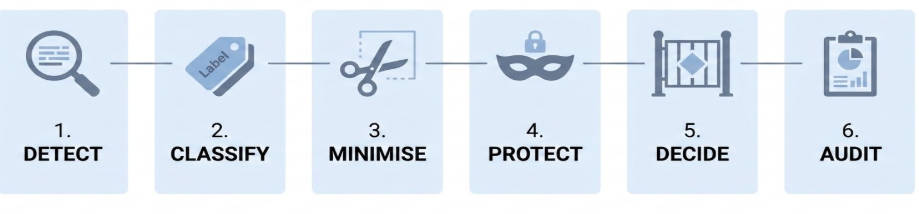
To establish safe AI adoption, we propose a 6-step lifecycle that must occur on the endpoint prior to external payload transmission:
- Detect: Real-time client-side scanning analyzes highlighted or selected text across any browser context.
- Classify: The engine categorizes detected entities into risk tiers.
- Minimize: Unnecessary context and superfluous personal identifiers are removed from the payload prior to submission.
- Protect (Mask/Anonymise): Low and medium-risk identifiers are automatically masked or pseudonymized using local client-side replacement.
- Decide (Gate Control): High-risk assets (such as passwords or API keys) trigger hard security gates, requiring mandatory user removal before proceeding.
Audit: Policy events, redaction counts, and data protection metrics are ingested into central security operations, such as Security Information and Event Management (SIEM) or Extended Detection and Response (XDR) systems, without storing the underlying sensitive text.
Practical Implementation: Where Waibloz LearnFlow Fits
Waibloz LearnFlow operationalizes this 6-step framework directly within the browser ecosystem. Acting as an inline security and intelligence layer, LearnFlow equips users with productive AI tools while helping protect data sent to underlying model providers.
Key Technical Capabilities
- Granular Risk Tiering: Differentiates between standard personal contact details (offering one-click masking options) and high-risk secrets like API keys and passwords (blocking submission until edited).
- In-Context Productivity: Combines inline privacy enforcement with immediate utility, including localized text summarization, multi-language translation and automated comprehension quizzes directly within the working tab.
- Security Integration: Integrates event logs with backend security dashboards to track enterprise-wide privacy events and policy enforcement in real time.
Strategic Recommendations for Security & Product Leaders
To establish robust AI governance while enabling workforce productivity, enterprise leadership should take the following steps:
- Audit Unofficial AI Touchpoints: Identify where employees interact with generative AI (browser extensions, web portals, unmanaged endpoints).
- Move Security to the Client Interface: Shift from network-level domain blocking to context-aware client-side inspection.
- Automate Data Minimization: Remove the manual burden of privacy compliance from end-users by automating redaction and masking.
- Establish Auditability for AI Workflows: Ensure your Data Protection Officer and CISO can review aggregate privacy reporting on prevented leaks and policy violations.
- Initiate Pilot Validation: Test inline security solutions with controlled focus groups (e.g., research teams, product managers, developers) to measure friction versus risk reduction.
Conclusion & Pilot Project Invitation
AI adoption does not require choosing between productivity and security. By placing an intelligent, inline data protection layer between browser content and remote AI systems, enterprises can substantially minimize sensitive data exfiltration while maintaining full operational speed.
Waibloz is actively collaborating with enterprise security teams, Data Protection Officers, and product leaders to validate pre-AI privacy architecture across live operational environments.
Engage in Further Discussion or Pilot Testing
We invite security researchers, CISOs, and innovation leaders to participate in our ongoing pilot validation program:
- Test LearnFlow: Evaluate our browser intelligence layer within your team.
- Review Technical Architecture: Discuss privacy event logging, regulatory alignment, and policy configuration.
- Co-Validate Use Cases: Shape pre-AI data protection controls tailored to your industry.
Contact Lead Author:
Rickard Erwison — Project Lead, Waibloz
Email: projects@waibloz.com
Website & Testing Access: Waibloz LearnFlow Platform
Glossary of Abbreviations
- API: Application Programming Interface
- CISO: Chief Information Security Officer
- DPO: Data Protection Officer
- GDPR: General Data Protection Regulation (Regulation (EU) 2016/679)
- NIS2: Network and Information Security Directive 2 (Directive (EU) 2022/2555)
- PII: Personally Identifiable Information
- SIEM: Security Information and Event Management
- XDR: Extended Detection and Response
References
- European Parliament and Council of the European Union. (2016). Regulation (EU) 2016/679 (General Data Protection Regulation). Official Journal of the European Union.
- European Parliament and Council of the European Union. (2022). Directive (EU) 2022/2555 (NIS2 Directive) & EU Artificial Intelligence Act Framework. Official Journal of the European Union.